Industrial Pipe Flange Manufacturing Process Explained
Author:Mingde Time:2026-02-20 10:51:51 Click:114
In modern pipeline engineering, the Industrial Pipe Flange is a key component used to connect pipes, valves, pumps, and equipment into safe and maintainable systems. Behind every reliable flange is a professional Industrial Pipe Flange manufacturer supported by stable factory production capability and scalable bulk supply systems.
From oil and gas transmission to water treatment and chemical processing, industrial pipe flanges must deliver strength, sealing, and dimensional accuracy. This article explains the complete manufacturing process inside a factory and how production control ensures consistent performance for large-scale pipeline projects.

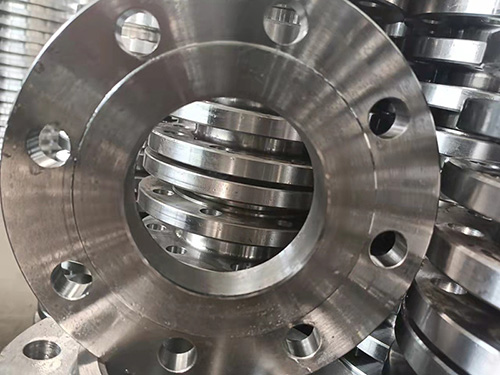
The Importance of Industrial Pipe Flange Manufacturing
An industrial pipe flange is more than a simple ring of metal. It must withstand pressure, temperature, vibration, and corrosion over long service periods.
Quality manufacturing influences:
·Load-bearing capacity
·Sealing reliability
·Dimensional precision
·Fatigue resistance
·Installation safety
A professional industrial pipe flange factory integrates engineering design with controlled production workflows to guarantee stable quality across mass manufacturing and bulk delivery.
Step 1: Raw Material Selection and Inspection
Manufacturing begins with material control. Common materials include carbon steel, stainless steel, and alloy steel.
Inside an industrial pipe flange factory, manufacturers perform:
·Chemical composition testing
·Mechanical property verification
·Surface defect inspection
·Batch traceability labeling
Material quality directly affects strength and corrosion resistance. By controlling input materials, the manufacturer protects consistency throughout production and bulk supply.
Step 2: Cutting and Forging Preparation
After inspection, materials are prepared for shaping.
Production operations include:
·Saw cutting or flame cutting
·Billet heating
·Pre-form shaping
Forging is widely used for industrial pipe flanges because it refines grain structure and improves mechanical properties. Factory production systems monitor temperature and deformation to avoid cracks or internal stress.
This stage determines the fundamental strength of the flange body.
Step 3: Forging and Forming Process
Forging creates the primary geometry of the industrial pipe flange.
Key processes include:
·Open-die forging
·Ring rolling
·Closed-die forming
These methods improve density and load resistance. In factory manufacturing, automated forging equipment ensures dimensional stability for large-volume production. Consistent forming supports reliable performance across bulk manufacturing batches.
Step 4: Heat Treatment and Stress Relief
After forming, industrial pipe flanges often require heat treatment.
Heat treatment may involve:
·Normalizing
·Quenching and tempering
·Stress relieving
These processes improve toughness and reduce residual stress. A professional industrial pipe flange manufacturer controls furnace temperature and cooling cycles to protect microstructure and long-term durability.
This step ensures that flanges perform reliably under pressure and temperature variation.
Step 5: CNC Machining and Dimensional Control
Machining transforms forged blanks into finished industrial pipe flanges.
Factory production includes:
·CNC turning for outer and inner diameters
·Drilling bolt holes
·Facing sealing surfaces
·Chamfering edges
Precision machining ensures accurate alignment and uniform gasket compression. Industrial pipe flange factories use CNC automation to control tolerances across thousands of units, supporting stable bulk supply for infrastructure projects.
Step 6: Drilling and Sealing Surface Processing
Sealing performance depends on surface quality.
Manufacturing operations focus on:
·Flatness control
·Surface roughness adjustment
·Bolt circle accuracy
·Face type machining
Whether raised face, flat face, or ring-type joint, factory production maintains sealing geometry. Manufacturers inspect surface finish to prevent leakage in high-pressure pipeline systems.
Step 7: Surface Treatment and Corrosion Protection
Industrial pipe flanges often work in aggressive environments. Surface protection is essential.
Common treatments include:
·Hot-dip galvanizing
·Anti-rust coating
·Painting
·Passivation
Before coating, factory production lines clean and prepare the surface. Manufacturers measure coating thickness and adhesion to ensure long-term corrosion resistance across bulk manufacturing.
Good surface protection extends service life and reduces maintenance costs.
Step 8: Quality Control and Testing
Quality inspection is embedded throughout production, but final checks confirm performance.
An industrial pipe flange factory conducts:
·Dimensional inspection
·Visual examination
·Mechanical testing
·Surface finish measurement
·Random load sampling
Batch records ensure traceability. Manufacturer-grade quality control ensures that only qualified flanges enter packaging and bulk supply channels.
Step 9: Packaging and Bulk Supply Preparation
After approval, flanges are prepared for shipment.
Packaging focuses on:
·Damage prevention
·Moisture protection
·Clear identification
·Efficient palletizing
Bulk supply planning ensures safe transport and easy installation at project sites. A professional industrial pipe flange factory integrates logistics with production to support on-time delivery for large orders.
Automation and Digital Manufacturing in Flange Production
Modern industrial pipe flange manufacturing increasingly adopts automation.
Benefits include:
·Real-time production monitoring
·Reduced human error
·Faster cycle times
·Consistent quality
·Scalable factory manufacturing
Digital systems help manufacturers maintain stability while expanding production capacity for bulk orders.
Applications of Industrial Pipe Flange
Industrial pipe flanges are widely used in:
·Oil and gas pipelines
·Power generation
·Water and wastewater systems
·Chemical processing
·Construction infrastructure
Each application requires reliable manufacturing and material control to ensure safety and long service life.
Conclusion: Value Created by Industrial Pipe Flange Manufacturing
In conclusion, the performance of every Industrial Pipe Flange begins inside a professional factory manufacturing system. From raw material inspection and forging to machining, surface treatment, and bulk supply preparation, each production step influences reliability and service life.
By integrating engineering design with scalable production capability, an industrial pipe flange manufacturer ensures consistent quality, safe operation, and dependable bulk delivery for modern pipeline systems.
For industrial projects, choosing high-quality industrial pipe flanges supported by strong factory production is essential to building durable, efficient, and future-ready pipeline networks.
References
GB/T 7714:Link R E. An introduction to the design and behavior of bolted joints[J]. Journal of Testing and Evaluation, 1991, 19(5): 417-418.
MLA:Link, R. E. "An introduction to the design and behavior of bolted joints." Journal of Testing and Evaluation 19.5 (1991): 417-418.
APA:Link, R. E. (1991). An introduction to the design and behavior of bolted joints. Journal of Testing and Evaluation, 19(5), 417-418.
 Hot Products
 Contact Us
Contact:
Mobile:+86 +86 19133378808
Website:mingdepipe.com
Address: